
Updated on:12/06/2025 05:22 PM 
In today's digital landscape, social media platforms face unprecedented challenges in combating misinformation. X, formerly Twitter, has introduced Community Notes as an innovative approach to addressing this critical issue. As a senior editor at CryptoSlate with firsthand experience using this system, I've observed both its revolutionary potential and significant limitations in our quest for accurate information dissemination.
Community Notes empowers users to provide context to potentially misleading content. When a note receives sufficient approval from a diverse range of contributors, it becomes publicly visible, enhancing the informational quality across the platform. This pioneering model, which champions the principle of "freedom of speech, not reach," has generated considerable debate within both tech and blockchain communities.
Visionaries like Ethereum co-founder Vitalik Buterin have commended this feature for its alignment with fundamental blockchain values of decentralization and community governance. However, legitimate concerns persist regarding potential exploitation, as demonstrated by recent coordinated attacks against corporate advertising campaigns. Despite X's claims of enhanced efficiency, noticeable delays in fact-checking processes continue to undermine the system's effectiveness.
The Community Notes network functions as an essential safeguard in the information ecosystem. While this decentralized approach remains imperfect, it establishes unprecedented levels of transparency and community-led content moderation.
Nevertheless, several critical areas require immediate attention. Establishing a robust framework for Community Notes contributors is paramount. Clear, knowledge-based participation criteria must be implemented to prevent the platform from devolving into a battleground of competing narratives rather than a space for factual clarification.
During my recent experience contributing under an anonymous pseudonym, I observed how this anonymity enables fact-checking participation while shielding contributors from potential backlash or online harassment. This protection mechanism appears particularly valuable when controversial Community Notes face opposition.
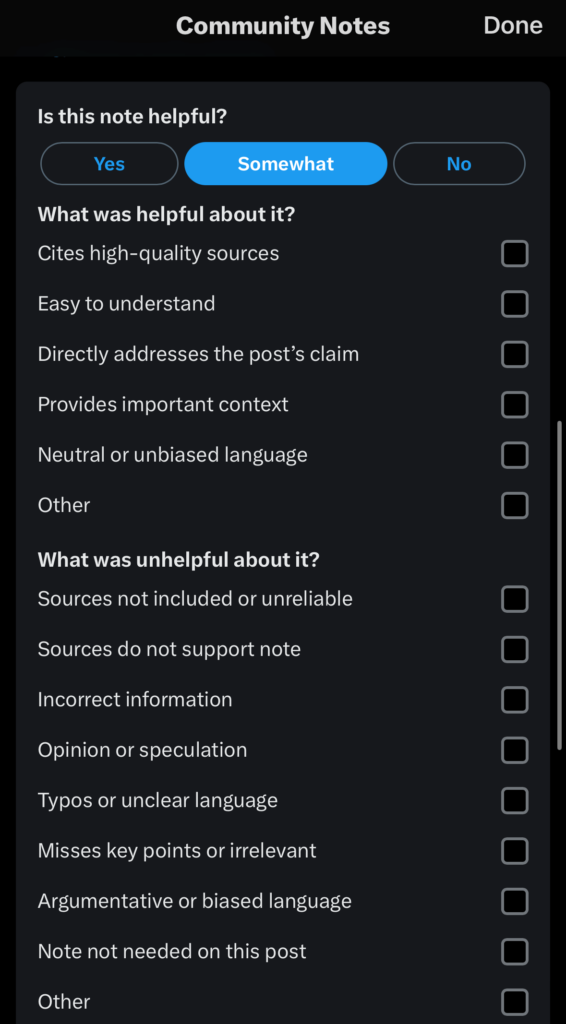
Yet, this raises an important question: Does anonymity compromise the integrity of the fact-checking process? The system permits verification of any content on X, including articles published by competing platforms. As a contributor, I could theoretically challenge information from other media organizations, with the Community Notes community ultimately determining the validity of such claims.
Concurrently, Community Notes participants can potentially target any X user, including competitors, with fact-checks. This raises critical concerns: Does the broader fact-checking community possess adequate tools to counteract malicious attempts to discredit legitimate content? While I personally adhere to ethical guidelines in my contributions, the same cannot be guaranteed for all participants.
Furthermore, despite X's assertion that fact-checking operates under decentralized control, minimal vetting appears to determine who qualifies as a fact-checker. Should a coordinated group gain influence within Community Notes and collaborate to disseminate misinformation, validating false claims through manipulated community votes, how would X respond? Would a centralized team intervene to remove contested notes? What prevents arbitrary removal of other legitimate notes? Most importantly, how would users become aware of such removals?
Despite these reservations, Community Notes represents a groundbreaking opportunity for user participation in information quality regulation. While not always aligned with Elon Musk's broader vision, this initiative reflects a compelling philosophy of community governance.
Community-driven fact-checking signifies a move toward self-regulation that merits support. It represents a paradigm shift toward social media platforms that are participatory, interactive, and accountable to their users.
However, the current implementation requires refinement, and several critical challenges must be addressed. Like powerful tools in any domain, the ultimate value of Community Notes depends on its implementation—whether it enhances information quality or becomes manipulated to exacerbate existing problems.
Based on my analysis, Community Notes should focus on these key improvement areas rather than abandoning the concept of community-driven fact-checking:
The underlying principle here is that large, diverse groups can collectively arrive at more accurate conclusions than individual experts. This diversity of perspective naturally counterbalances personal biases. X appears to be leveraging this concept through its Community Notes implementation.
Early research by Francis Galton in 1907 demonstrated this phenomenon when a crowd at a fair more accurately estimated the weight of an ox than individual animal experts. This study highlighted the remarkable power of aggregated opinions. James Surowiecki later popularized this concept in his 2005 book "The Wisdom of Crowds," demonstrating how collective intelligence emerges under appropriate conditions.
Contemporary research continues to validate the "wisdom of crowds" principle. A 2017 study revealed that groups consistently outperformed individuals in answering general knowledge questions, with larger groups demonstrating superior results.
Notably, researchers at MIT discovered that groups of individuals could predict startup success rates more accurately than individual venture capital experts. Crowdsourcing has proven effective for solving complex problems across mathematics, engineering, and computer science domains. This suggests that expanding the Community Notes contributor base might enhance the system's overall effectiveness.
However, research also indicates that crowds can sometimes converge on misinformation and transform into digital mobs under certain conditions. The preservation of diverse viewpoints and independent thinking remains essential to preventing this outcome.
While still evolving, Community Notes demonstrates significant potential as a crowdsourced approach to fact-checking and misinformation regulation. Like any system dependent on public participation, risks of bias and manipulation persist. However, with thoughtful design iterations and strategic incentive structures, the collective intelligence of the community could substantially improve online information quality.
Community-driven moderation resonates deeply with blockchain's decentralized philosophy. When implemented responsibly, this approach could pioneer a new path for social platforms seeking to balance free expression with accountability. The journey forward demands continuous vigilance, enhanced transparency, and adaptability to emerging challenges. Through careful cultivation and innovative thinking, we may yet develop online communities capable of navigating complex information landscapes with integrity.
UPDATE: Incorporated additional reference to X's documentation regarding diversity of perspectives in community fact-checking.
