
Updated on:12/03/2025 04:22 PM 
Recent observations by renowned economist Turr Demeester have brought attention to an unconventional metric tracked by the St. Louis Federal Reserve – the fascinating ratio between egg prices and Bitcoin value. This unusual comparison has sparked curiosity across financial circles, especially considering that cryptocurrency remains a novelty in everyday transactions like grocery purchases.
The central question emerges: why would a major financial institution monitor such an atypical economic pairing?
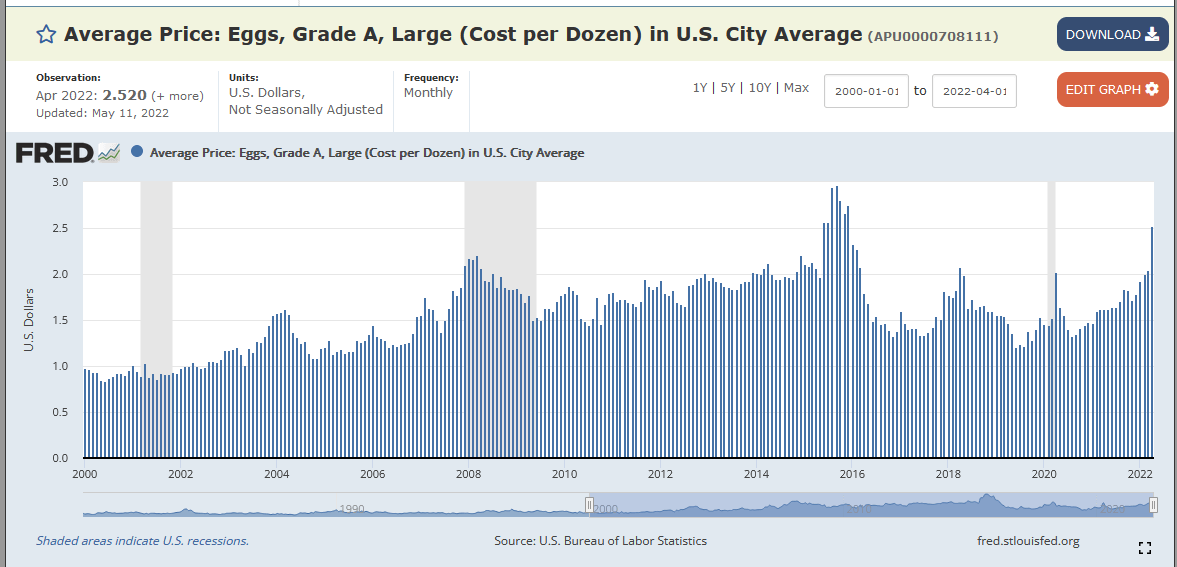
The St. Louis Federal Reserve maintains comprehensive data on the monthly average pricing of grade A large chicken eggs when valued against the US dollar. This established practice forms the foundation for their more recent cryptocurrency analysis.
Examination of the dollar-based egg pricing chart since 2000 reveals a consistent upward trend. Notably, prices reached their zenith at $2.97 per dozen in September 2015, followed by a significant correction that eventually stabilized at approximately $1.20 by June 2019 before resuming their ascent.
Supporting documentation explains why food and energy categories are typically excluded from core monetary policy assessments like the Consumer Price Index, which serves as a primary inflation measurement tool.
The innovative concept of applying this same methodology to Bitcoin rather than traditional currency originated with statistical experts at the St. Louis Federal Reserve. While comprehensive historical data extending back to 2000 isn't available due to Bitcoin's emergence in 2009, the organization's records extend back to January 2015, providing substantial analytical material.
The Bitcoin valuation of eggs is calculated by dividing the average price of a dozen grade A large eggs by the current Coinbase Bitcoin price, then multiplying by 1,000,000,000 to express the result in satoshis – Bitcoin's smallest denomination.
Intriguingly, data analysis reveals a distinct downward trajectory in Bitcoin-denominated egg prices. The chart below demonstrates that from Q4 2019 onward, the Bitcoin price becomes virtually negligible, suggesting that fewer satoshis are required to purchase a dozen eggs over extended periods. This alternative perspective indicates Bitcoin's increasing value relative to everyday consumer products.

According to Demeester, although the initial comparison between eggs and Bitcoin began as commentary on cryptocurrency volatility, its official acknowledgment by the Federal Reserve serves as unexpected validation of Bitcoin's economic significance.
However, what the St. Louis Federal Reserve hadn't anticipated was the long-term comparative analysis that would emerge from their data collection. The divergent trajectories of the dollar-based and Bitcoin-based egg charts provide compelling evidence of Bitcoin's strengthening purchasing power against tangible, real-world commodities.
This stands in stark contrast to the traditional US dollar, which has demonstrated declining purchasing power over comparable periods. The Federal Reserve's own data inadvertently showcases Bitcoin's potential as an inflation hedge when examined through this unconventional but revealing economic lens.
