
Updated on:11/26/2025 01:40 PM 
Derrick Foote is a dedicated Web3 advocate committed to constructing a decentralized internet with transparency and trust, aiming to restore data sovereignty and privacy to users. Active in the blockchain sector since 2013 and a graduate of a Toronto-based blockchain strategy program, Derrick has spent years educating the public about distributed ledger technology, managing several high-profile OTC deals, and engaging in commercial mining. For the past three years, his focus has shifted towards blockchain and IPFS (InterPlanetary File System) software development.
In 2017, he founded Temporal, a scalable IPFS infrastructure platform designed to help developers build production-ready applications on top of IPFS rapidly, using familiar tools and languages like Golang and JavaScript.
Despite its futuristic name, IPFS remains a widely misunderstood topic. In this interview, we explore the potential applications of IPFS, the challenges of creating a seamless user experience for developers, the impact of Ethereum 2.0, and much more.
Could you share your background and how you first entered the crypto space?
DF: My journey into cryptocurrency began in 2013 when I was introduced to Bitcoin. I immediately grasped the vision Satoshi had and the revolutionary potential it held. This curiosity drove me to delve deeper into the technology. Before I knew it, I was mining Bitcoin around the clock for the next five years. I then pivoted to community building, starting a group called Merit Change to help crypto enthusiasts connect, learn, and grow collectively. We focused on mitigating risks like hacks, rookie mistakes, and fraudulent projects. My passion for blockchain deepened, and I met many incredible people through this community. Shortly after, I decided to self-fund a technology company called RTrade Technologies Ltd., initially focusing on GPU mining before transitioning to blockchain development, including smart contracts and IPFS. Since then, we've run a successful pre-ICO, secured major development contracts, and built innovative products that are gaining traction in the industry.
What motivated you to create Temporal, and what is its mission?
DF: We launched the Temporal project in early 2017 after our co-founder and lead developer, Alex Trottier—whom I met through the Merit Change community—introduced me to IPFS. I was instantly fascinated. We shared a passion for the technology and its three core features: content addressing, data verification, and data de-duplication. We knew these would fundamentally improve the internet, fixing many issues with HTTP. We realized there was a significant gap in helping users and developers understand and adopt the technology, as no one was focused on this at the time. Our mission was to create the infrastructure that not only supports Web3 but also enables people to build and integrate with this technology, facilitating mainstream adoption.
Where is your team located, and what was the reasoning behind this choice?
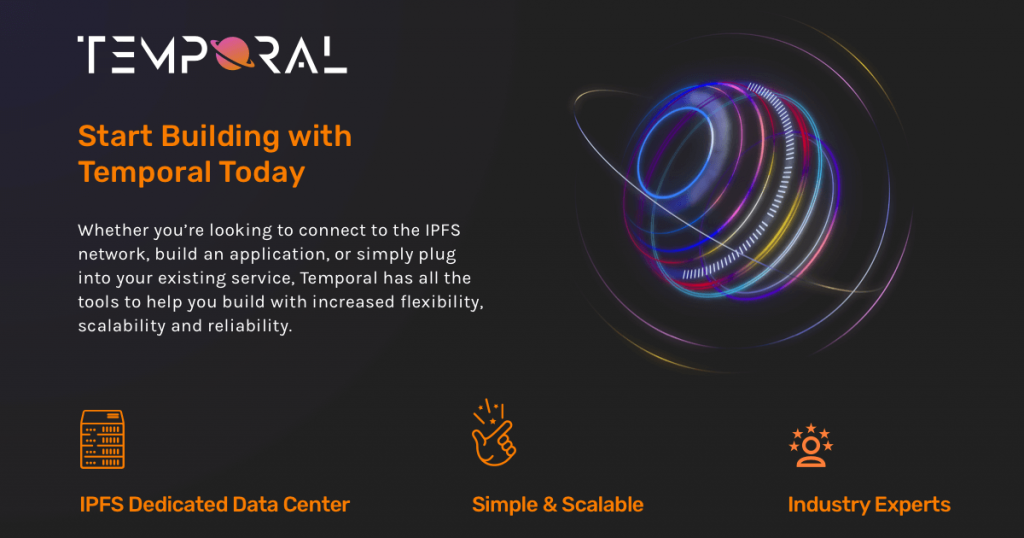
DF: Our team is based in Toronto, Canada, primarily because it's home for many of our core team members. It's also where our dedicated IPFS data center is located, which gives us direct control to build and improve upon IPFS infrastructure for our clients and users.
What are some of Temporal's most notable achievements or milestones?
DF: A significant achievement is that we are the only IPFS implementation not built on standard cloud services, leading to extreme cost savings for our users by avoiding high data storage, CPU hours, and bandwidth costs. This ensures our clients can store their data with confidence, knowing we maintain full control of the environment and aren't vulnerable to a cloud provider arbitrarily decommissioning our services.
RTrade has also achieved several other major milestones for IPFS that we're proud of, including the first Amazon S3-compatible IPFS server, an IPFS WeChat mini-app, a fully-supported IPFS website, our Private IPFS Data Center, an IPFS S3 API Gateway, and tools for managing private IPFS networks.
What are the primary benefits of using Temporal over other IPFS solutions?
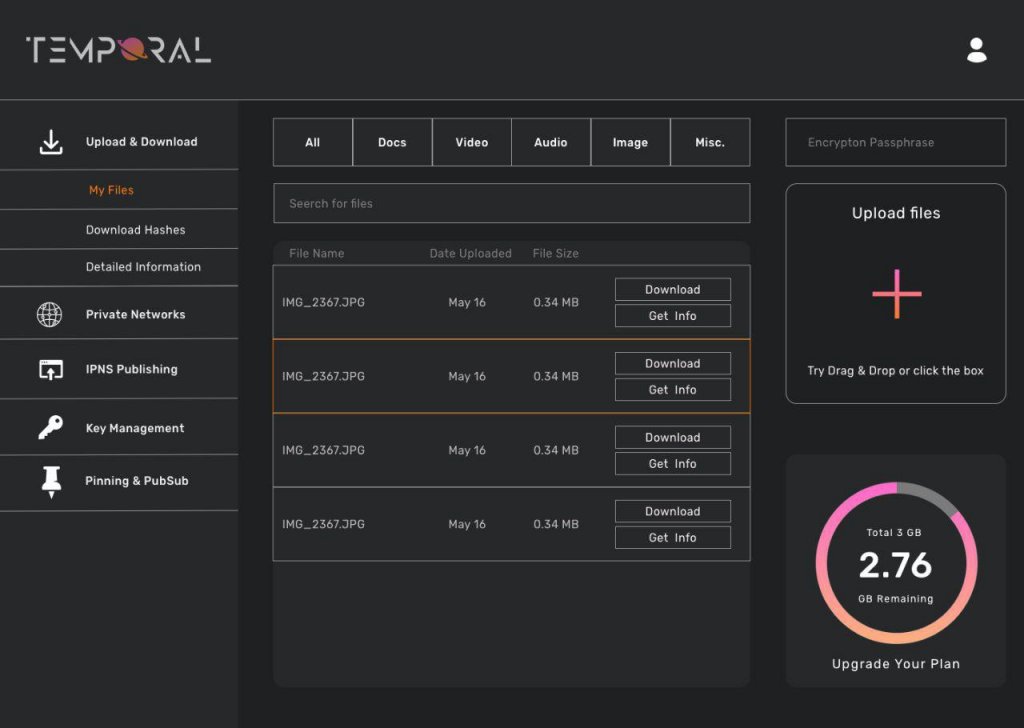
DF: The key advantages are pricing, functionality, scalability, and security. With Temporal, users can leverage everything IPFS offers plus additional features like pinning services and a built-in IPFS search engine. By leveraging our dedicated IPFS data center, we offer the cheapest hosting service in the space—by about 60-70%, starting at $0.05/GB with 3GB free. Our platform and tools allow clients to scale up or down as needed. We have incredibly robust support and redundancy measures in place, coupled with an extensive privacy policy that includes a pledge to never share or sell user data.
What is the biggest misconception about IPFS?
The most widespread misconception is that IPFS is a free, magical cloud storage where you can content and it persists forever without any intervention. That's simply not how it works.
What do you foresee being the most popular IPFS applications in the future?
Can you share details about Temporal's product roadmap? What upcoming features are you most excited about?
I believe the most widely used IPFS applications in the future will be content delivery networks (CDNs). We will also see IPFS being used extensively for all aspects of data archival and content hosting.
DF: I'm most excited about our integration with ENS Domains, which will allow users to host their IPFS websites instantly using an ETH address, making them Web3-ready. Following that is our S3-compatible API, which will enable any application that currently uses S3 to switch to IPFS without any code modifications. I'm also very excited about multi-network IPFS capabilities and, eventually, deploying Temporal Cloud via Kubernetes. Kubernetes will allow us to spin up and manage highly available IPFS clusters on demand, along with finer-grained controls for monitoring and configuring IPFS nodes.
What are the biggest challenges in building an IPFS platform for developers?
DF: Beyond enhancing the stability and functionality of IPFS itself, a major challenge we face, both with IPFS and the broader blockchain space, is creating a better user experience (UX/UI). We need to enable people to navigate and perform complex actions with just a few clicks to get the benefits of the platform, without requiring expert-level knowledge.
What other projects or blockchain developments are you most excited about?
DF: This changes constantly, but right now, it's ENS Domains. It has successfully bridged a critical gap in the industry and will be a key privacy layer for Web3.
What impact do you believe ETH 2.0 will have on the developer community?
DF: If ETH 2.0 rolls out as planned, it will solve many of the limitations developers face when building on Ethereum, such as high gas fees and network latency. With ETH 2.0, we'll be able to create the next generation of dApps and move Ethereum closer to becoming a world computer. I'm personally excited about the rollout; they have a fantastic team with immense talent and a top-tier community.
Do you have any blockchain or crypto predictions for 2020 and beyond?
DF: A significant Bitcoin pump before the halving.
What are the biggest obstacles to the mainstream adoption of crypto?
DF: Regulation. Technology always outpaces regulation, which inevitably forces innovation to slow down. We also need more real-world use-cases. There need to be more practical applications beyond just trading and speculation.
What is your most controversial opinion relating to blockchain or cryptocurrency?
DF: Craig Wright is the real Satoshi. Just kidding, you asked for controversial, not delusional. My most controversial opinion is that many blockchains claiming to be decentralized are, in fact, far from it. It's frustrating to look deeper into the technology only to find hidden points of centralization and trust.
For more information:
Disclaimer: Temporal is an advertiser on CryptoSlate but this is not a sponsored article.
