
Updated on:12/11/2025 05:51 PM 
The rapidly evolving cryptocurrency landscape recently witnessed a sophisticated social engineering attack that successfully deceived multiple prominent crypto news platforms into promoting a fraudulent $10 million Uniswap airdrop on February 16. The perpetrator, impersonating a Uniswap Foundation official, orchestrated an elaborate scheme offering coordinated publicity alongside the legitimate Uniswap v4 announcement.
While CryptoSlate wisely declined to cover the suspicious airdrop due to concerns about potentially malicious tracking links, several other industry outlets fell victim to the deception. Despite Uniswap's v4 announcement being authentic, the accompanying airdrop was subsequently exposed as an elaborate scam designed to exploit the excitement around the platform's major update.
The scammer demonstrated remarkable attention to detail, building credibility through references to conversations with "Uniswap's VP of Communication" and proposing favorable financial terms. This level of coordination marks a concerning evolution in tactics employed by malicious actors targeting the crypto media ecosystem.
As discussions about potential partnership continued, the scammer progressively increased the sophistication of their deception. The forged email sent to CryptoSlate below illustrates the elaborate measures taken to legitimize the campaign.
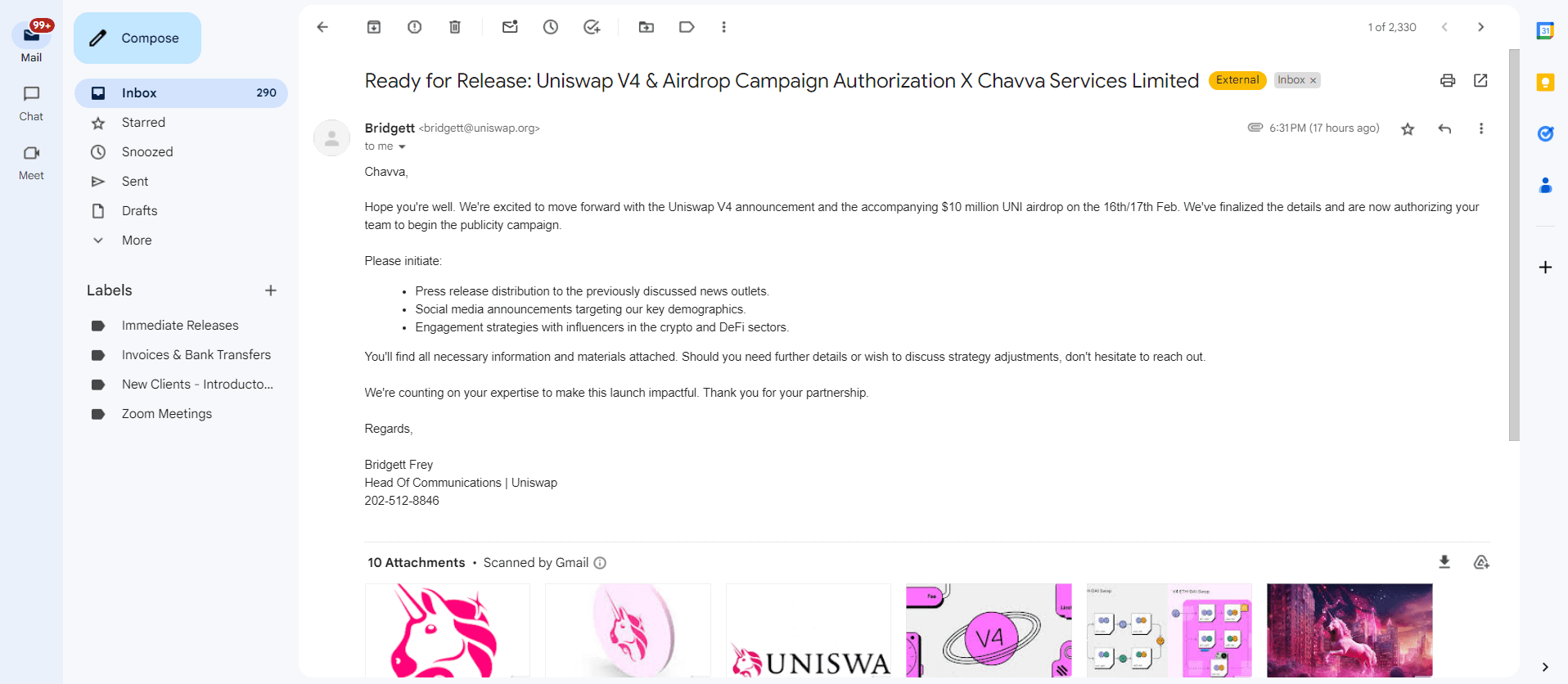
Upon closer examination, CryptoSlate identified the use of redirect-based tracking links rather than standard UTM parameters, indicating that the links could be modified to direct users to any website at any time without the publication's knowledge or consent.
When confronted with these findings, the scammer terminated all communication. The entity behind this operation is registered in the United Kingdom, which ranks among the top jurisdictions for crypto-related criminal activities in 2023.
The fraudulent article, successfully published across numerous cryptocurrency media platforms, falsely reported the launch of Uniswap V4 alongside a purported $10 million UNI airdrop. The piece included authentic links to the Uniswap website, which were subsequently altered to point to a phishing site following Uniswap's actual announcement.
Specifically, the scam claimed a generous $10 million UNI airdrop to celebrate the V4 launch, describing it as a "first-come, first-serve" initiative intended to reward the community and attract new users. This approach contrasted with legitimate airdrop distributions, which typically reward users based on previous wallet activity rather than a first-come, first-serve basis.
In contrast, the legitimate Uniswap V4 announcement focused on the platform's development timeline, including core code completion, testing phases, gas optimization efforts, and security enhancements. The genuine announcement highlighted a community audit contest and testnet deployment as preparatory steps for the mainnet launch, tentatively scheduled for Q3 2024.
While no direct financial losses to readers have been reported at the time of publication, this incident significantly erodes trust within the cryptocurrency community. For reputable news organizations, maintaining credibility remains paramount. In the aftermath, industry participants will likely implement enhanced measures to safeguard against increasingly sophisticated social engineering attacks.
This case underscores the inherent risks in the fast-paced cryptocurrency news environment. Media outlets face growing pressure to break impactful stories quickly but must balance this with thorough source verification. The scammer's use of self-destructing messages further complicates post-incident investigations.
The incident serves as a crucial reminder of the due diligence required in crypto journalism. In this instance, the fraudulent airdrop scheme closely paralleled a major legitimate product announcement, enhancing its perceived credibility. Journalists are encouraged to maintain healthy skepticism and employ rigorous verification techniques, even when presented with seemingly urgent and compelling opportunities.
