
Updated on:11/30/2025 02:39 PM 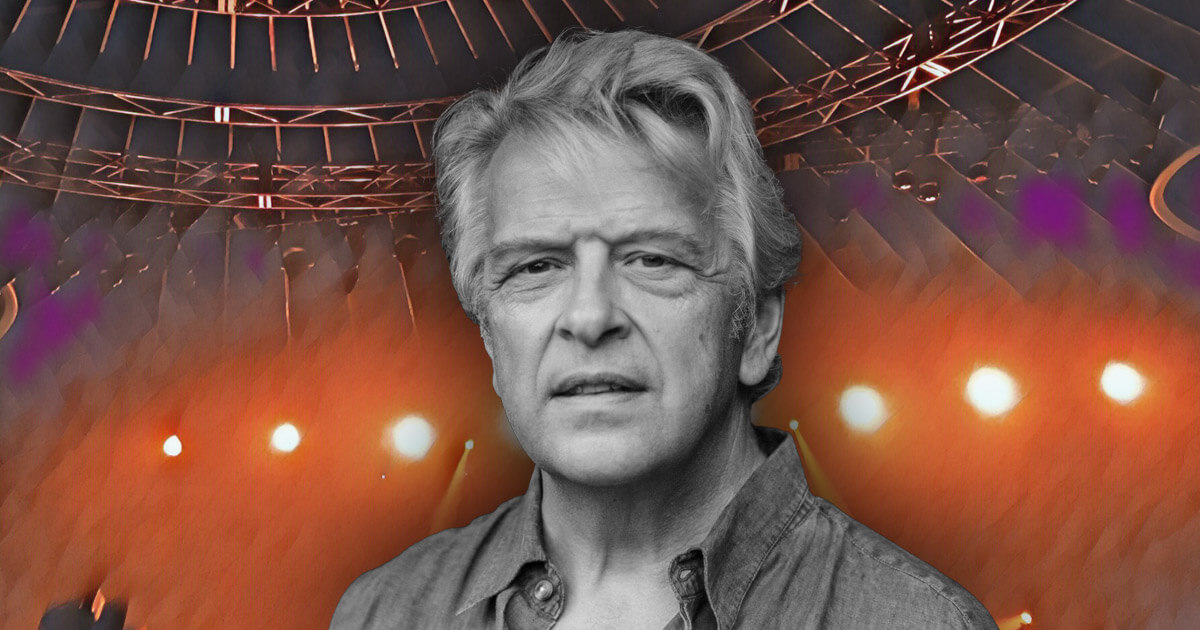
CryptoSlate had the privilege of speaking with world-renowned producer Tony Hollingsworth. Tony is the visionary founder of Center Anew, a project that will grant holders access to exclusive social impact NFTs featuring some of the planet's biggest actors, musicians, artists, and writers.
With over 30 years of experience collaborating with companies, governments, and foundations at the intersection of humanitarian efforts, media, and popular culture, Tony's credentials are formidable. His portfolio conceiving and producing the global media campaign that reached 600 million people, which successfully repositioned Nelson Mandela from "black terrorist leader" to "black leader," to consulting for the US White House on a public campaign in response to 9/11.
Over the past three decades, Tony has worked with well over 200 of the world's top creative artists, from Stevie Wonder to Ravi Shankar, from Denzel Washington to Natalie Portman, and from Paul McCartney to Keith Haring.
What is your professional background, and how did you get into crypto?
I've produced several of the world's largest global media events and have always used cutting-edge technology to achieve what everyone else thought was impossible. Modern technology has always fascinated me, and when my son—who has been investing in blockchain businesses for several years—introduced me to the crypto space, I immediately saw how revolutionary it was going to be.
What is Center Anew, and what are its primary goals? What made you decide to establish it?
Center Anew is an annual and global media campaign for vulnerable and underprivileged children, of which there are 1 billion in the world. It's an enormous problem, one we seldom hear about. The campaign brings together major stars and creative artists, along with the world's biggest media partners, so we can 'listen' to the problems these children face and celebrate and support the solutions that already exist and are ready to be scaled.
I remember the exact moment I decided to set up Center Anew. Having worked on major causes like freeing Mandela and ending Apartheid, I was thinking about what issue we should tackle next. Children were very much on my mind. One day, while putting one of my children to sleep and listening to the BBC World Service radio, I heard an African mother being interviewed whose child had just died of diarrhea. She could have saved him with a 10-cent sachet and some clean water, but she had neither. The injustice of the situation hit me hard; if my child was even slightly ill, we could call a doctor. But this mother had nothing.
What was your experience working with some of the biggest names in the music industry?
I have too many stories—some I can share and some I can't! I've had the privilege of working with over 200 of the world's biggest music stars, including Stevie Wonder, Pavarotti, Dire Straits, Bob Dylan, Mary J. Blige, Whitney Houston, Elvis Presley, B.B. King, Diana Ross, Michael Jackson, Jon Bon Jovi, Keith Richards, MC Hammer, Roger Waters, Sinead O’Connor, The Police, Bee Gees, Chris de Burgh, Chaka Khan, and many more.
I have so many memories, and the candid moments we captured on camera are the memories that will be minted as NFTs and treasured as time capsules by whoever ends up owning them. When challenges arose organizing and running the events—which happened a lot!—all of them responded with incredible creative solutions that resulted in very special moments that I will always cherish.
What do you think some of those hugely famous musicians you worked with would make of cryptocurrency and blockchain?
Well, great artists are natural innovators. I imagine that if David Bowie were here, he would have been one of the first to embrace blockchain technology. Visual artists and musicians are already collecting NFTs, and artists like Ashton Kutcher are using them in ways that will likely change how theatre shows are funded and marketed forever. Knowledge and innovation truly go hand in hand.
What do you believe are the biggest obstacles for mainstream adoption of crypto and blockchain?
There are three obstacles I can see. First, there needs to be clear, official, and educational content. Second, there needs to be a straightforward and consistent wallet experience that is as simple to use as PayPal. And third, transaction fees need to be as low as credit card payments. Once we solve all three—and solve them we will—mainstream adoption is just a matter of time.
What does Center Anew do that others don't? Do you think more projects will be established to try and use blockchain for good?
Center Anew is the first project bringing exclusive and iconic cultural content to the blockchain by creating NFTs from performances by the biggest creative stars of the last 40 years. Then, from summer 2022 onwards, we will have a pipeline of star content from the annual Center Anew events that we will be turning into a steady stream of rare NFTs, auctioned on our Center Collectibles Auction & Marketplace over the next decade.
How important is it that blockchain and crypto usability and user experience is improved?
The end-user has very high expectations. They are used to the ease and quality of making PayPal payments, ordering Ubers, and booking Airbnbs—all with just a few simple clicks and swipes, without any knowledge of the underlying code or data strategy. For crypto to reach the same level of mainstream proliferation, the user experience has to be at that same high level.
We designed our Collectibles Auction & Marketplace from the ground up to make the process of buying NFTs as simple and straightforward as possible for a non-crypto audience. This is why we chose to build on the Flow blockchain, as it's super-fast, so users aren't waiting for transactions to clear, and it has tiny transaction fees, allowing everyday people to bid on NFTs without paying $50-$100 each time. Flow also allows native fiat payments, so users can pay with their credit cards. We anticipate reaching an audience of 500 million people every year, and many of them will not be crypto-native, so we had to ensure our NFT marketplace would be very easy for them to use.
Do you believe improvements in the way people experience and use crypto will drive adoption?
When we want to get something done, we all want to take the direct and easiest path. Beautifully designed user experiences do this for the user, allowing them to do what they want in the fastest and most intuitive way possible. The simpler crypto is to use, the more widespread its adoption will be.
What is your most controversial opinion relating to blockchain and/or cryptocurrency?
My most controversial opinion is that Ethereum is outdated, overrated, and environmentally devastating. The majority of projects are still choosing Ethereum as the technology on which to build, even though superior blockchain solutions exist.
